
Views: 0 Author: Site Editor Publish Time: 2026-01-23 Origin: Site


Portable aluminum lifts are highly valued for their practicality, safety, and versatility across a wide range of industries. Whether used in construction, maintenance, or warehouse operations, these lifts offer a quick and reliable solution for tasks that require elevation. In this article, we will dive deep into the mechanisms that make a portable aluminum lift work, providing insight into the components and operational features that make this equipment a smart choice for lifting tasks.
At the heart of any portable aluminum lift is its well-engineered structure and lifting mechanism. These components are designed to maximize safety, efficiency, and ease of use. Below, we explore the key mechanics that make these lifts function.
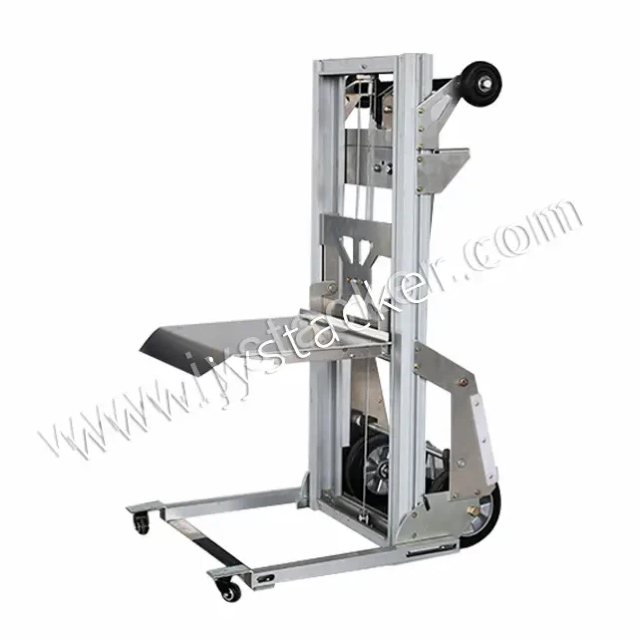
The mast is a critical component of any portable aluminum lift. It allows for vertical movement, enabling the platform to reach various heights. JYStacker’s portable aluminum lifts are designed with high-strength aluminum masts that provide both strength and lightweight mobility. These masts typically use telescoping mechanisms, allowing them to extend and retract smoothly. The ability to adjust the height in this manner ensures the lift can handle different tasks at varying elevations, offering versatility for users.
The telescoping mechanism works by using hydraulic or manual systems to extend the mast. As the lift is activated, the mast extends vertically, providing workers with the height they need. When not in use, the mast retracts for easy storage and transport.
The lifting mechanism is responsible for raising and lowering the platform of the portable aluminum lift. Different models of lifts use varying lifting systems depending on their design and intended use. Common lifting mechanisms include:
Hydraulic Systems: These systems use hydraulic fluid to generate pressure, which powers the lift’s movement. Hydraulic systems are known for their smooth and efficient operation, making them ideal for tasks that require precise control of the lift’s height.
Manual Systems: Manual lifts use mechanical methods, such as hand cranks or gears, to raise and lower the platform. While they require more physical effort, manual lifts are cost-effective and can be useful in environments where power sources are limited.
Assisted Systems: These combine elements of both hydraulic and manual systems, offering a balance between ease of use and cost-efficiency.
The lifting mechanism is designed for safe and controlled operation, ensuring that loads are raised steadily and securely without sudden movements.
The stability of a portable aluminum lift is crucial to its safe operation. Several structural principles are in place to ensure that the lift remains steady and secure, preventing tipping or wobbling.
The base of the portable aluminum lift is engineered to provide a broad, stable foundation. The wider the base, the less likely the lift is to tip over when under load. Proper weight distribution is also critical in maintaining stability. The platform and load should be evenly balanced to ensure that the lift maintains its center of gravity. Uneven weight distribution can compromise stability, leading to a potential accident.
At JYStacker, our portable aluminum lifts feature a wide base design to enhance stability. The base is carefully crafted to accommodate different loads and ensure that the lift remains grounded throughout its operation.
Most portable aluminum lifts are equipped with guardrails to protect workers from falls while they are operating the lift. These guardrails provide an extra layer of security, ensuring that workers remain safe even when working at heights. The platform surface is also designed to be non-slip, providing secure footing for the operator and preventing accidents that could occur from slipping.
A key advantage of portable aluminum lifts is their ability to be easily moved between locations, which is critical for tasks that require mobility or frequent repositioning.
The mobility of a portable aluminum lift is enabled by wheels or casters at the base. These wheels allow the lift to be moved with ease, even across uneven surfaces. Once the lift is positioned correctly, caster locks are engaged to keep the unit in place during operation. These locks ensure that the lift remains stable and secure while it is in use.
The mobility of the lift also plays a role in the speed and efficiency of tasks. Workers can quickly reposition the lift to access different areas without having to disassemble or manually move heavy equipment.
In addition to being mobile, portable aluminum lifts offer adjustable height features to accommodate different tasks. Height adjustment methods vary by model, but most lifts feature either hydraulic or mechanical systems that allow users to raise or lower the platform to the desired level. This adjustability makes it easier for workers to access various heights, from reaching high shelves to working on ceilings.
Safety is paramount when working at elevated heights. JYStacker portable aluminum lifts are equipped with several safety features that ensure smooth and secure operation. These systems are designed to prevent accidents and ensure the lift’s stability throughout the job.
Modern portable aluminum lifts come equipped with interlock systems, which prevent the lift from being operated unless it is properly positioned and locked. These interlocks ensure that the lift cannot be moved unintentionally while in use, preventing accidents.
In addition, many models feature an emergency stop or lowering function. This function allows the operator to halt the lift’s movement immediately in case of an emergency, ensuring that the platform is safely lowered in critical situations. Emergency stop buttons are typically placed in easily accessible locations for quick access.
Sensors are often integrated into portable aluminum lifts to detect unsafe conditions, such as overloading or obstruction. These sensors automatically stop the lift’s movement when an unsafe condition is detected, reducing the risk of accidents. Some lifts also feature safety stops that prevent the platform from rising beyond a certain height, ensuring that the lift is always within safe operational limits.
The convenience of portable aluminum lifts is enhanced by their simple setup and disassembly process. These lifts are designed to be easy to transport, store, and set up, making them ideal for temporary or mobile tasks.
One of the benefits of portable aluminum lifts is their compact design, which allows them to be broken down or folded for easy transport and storage. Most models feature a folding or collapsible frame, reducing the unit's size when not in use. This makes them easy to transport between job sites or store in small spaces when not needed.
Setting up a portable aluminum lift on-site is quick and simple. Once the lift is positioned in the desired location, the operator locks the wheels, ensures the platform is stable, and checks the lifting mechanism for smooth operation. The lift is then ready to be used, providing a safe and reliable platform for elevated tasks. The minimal setup time means that workers can quickly get to work, reducing downtime and improving overall productivity.
The design of a portable aluminum lift maximizes mechanical advantage and load distribution to ensure that the equipment operates efficiently and safely.
Component | Function | Benefit |
Telescoping Mast | Vertical lift | Adjustable height |
Caster Wheels | Move unit | Easy repositioning |
Locking System | Hold position | Safety |
The telescoping mast allows for easy vertical lifting, while the caster wheels enable fast repositioning. The locking system ensures the unit stays stable during operation, contributing to the overall safety of the lift.
Portable aluminum lifts are designed with a perfect balance of strength, mobility, and safety. The engineering behind these lifts ensures that they are a reliable and efficient solution for elevated work tasks, from maintenance to installation. With key features such as adjustable height, secure lifting mechanisms, and a stable base, portable aluminum lifts from JYStacker are built for both daily use and long-term durability.
At JYStacker, we are committed to providing top-quality lifting equipment that ensures maximum safety, efficiency, and performance. If you are in need of a reliable portable aluminum lift to streamline your worksite tasks, visit our website and explore our range of products. Contact us today for more information on how we can help you improve productivity and safety on your job site.
A portable aluminum lift is a lightweight, mobile lifting device made primarily from high-strength aluminum, designed to raise and lower materials or workers safely at various heights.
A portable aluminum lift works through a combination of telescoping masts, hydraulic or manual lifting mechanisms, and stability features like wheels and locking systems to raise and lower the platform safely.
Portable aluminum lifts are commonly used in industries such as construction, maintenance, warehousing, and facility servicing, where elevated access is required.
Regular maintenance involves inspecting the mast, checking for wear on the lifting mechanism, ensuring the wheels and locks are functioning, and performing scheduled lubrication and hardware checks.